


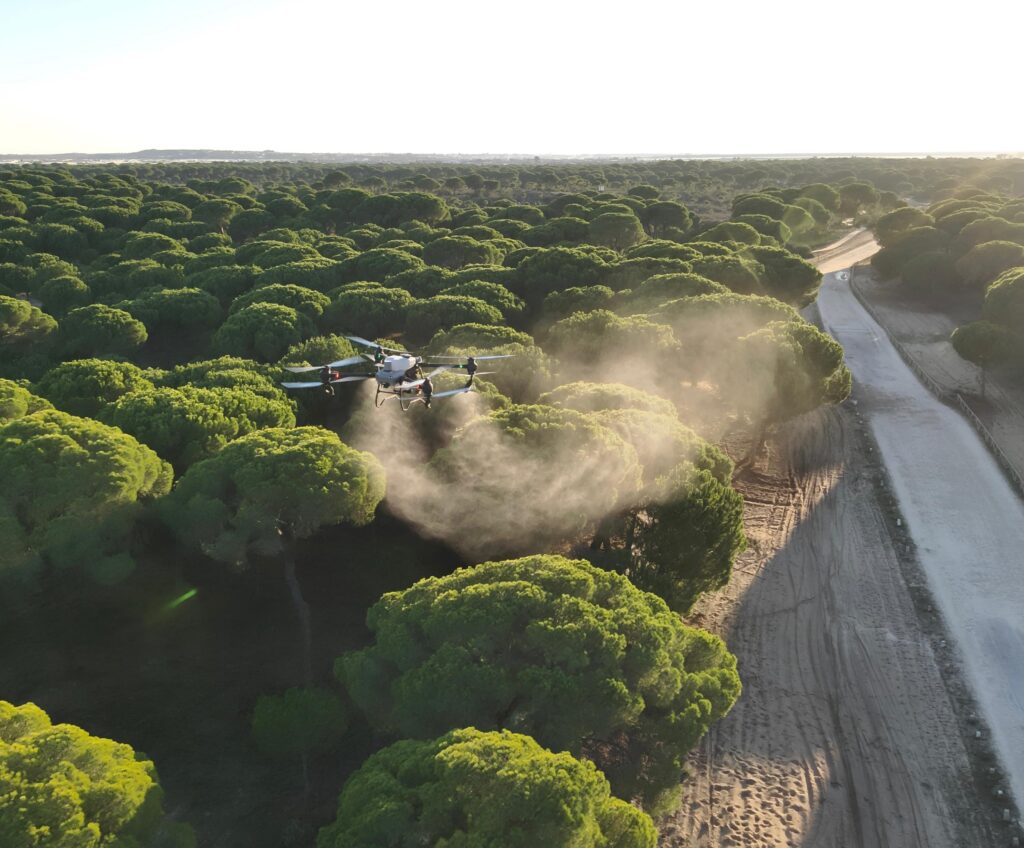
In November and December 2025, the Junta de Andalucía carried out aerial drone treatments for the control of the pine processionary (Thaumetopoea pityocampa) for the first time. This operation, which covered nearly 450 hectares distributed across the provinces of Cádiz, Huelva, Málaga and Seville, marks a milestone in Andalusian forest management and demonstrates how unmanned aircraft technology can offer more precise, safer and more environmentally friendly solutions.
BENIU participated in this pioneering campaign, contributing its expertise in aerial drone operations and helping to ensure that treatments were carried out with maximum effectiveness in hard-to-reach areas.
Why act against the pine processionary
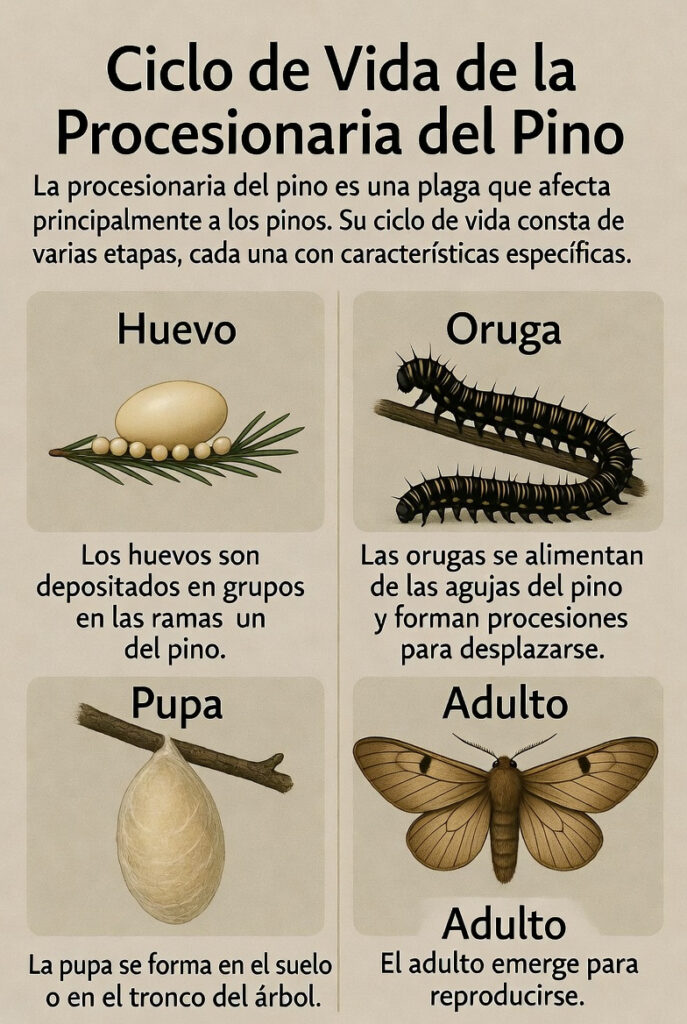
The pine processionary is one of the most well-known forest pests in the Iberian Peninsula. Its caterpillars feed on pine needles, causing defoliation that weakens the trees and makes them more vulnerable to other pathogens, especially in conditions of water or climate stress.
In addition to forest damage, the processionary poses a public health risk. The urticating hairs of the caterpillars can cause allergic reactions in people and domestic animals, a particularly relevant problem in recreational areas such as trails, picnic areas or natural spaces with high visitor numbers.
Intervention is necessary precisely in these areas, where human presence is common and where pest control has a dual objective: protecting the forest mass and ensuring the safety of those who enjoy the woodlands.
A precise and sustainable application technique
The use of drones for forest phytosanitary treatments offers significant advantages over conventional methods. The technique used in this campaign, called Ultra Low Volume (ULV), allows for homogeneous spraying that optimizes the effectiveness of the applied product and considerably reduces the quantity needed to achieve effective results.
The formulation used, based on 0.35% cypermethrin, has official registration for the control of this pest and is suitable for selective interventions in forest areas. The application dates, between November and December, coincide with the larval stages when treatment is most effective, following established forest health technical criteria.
Each flight generates a detailed technical record that captures parameters such as swath width, area covered and volume of spray applied. This traceability system ensures comprehensive monitoring of the entire process and allows results to be evaluated with precision.
Areas of operation in Andalusia
The campaign covered various forest areas in four Andalusian provinces, with a total executed area of 449.21 hectares.
Province of Cádiz
Treatments were concentrated in Huerta Grande (Algeciras) with 0.86 hectares, and in the Doñana natural area: the La Algaida pine forest in Sanlúcar de Barrameda (47.56 hectares) and the La Rocina woodland in Almonte (17.88 hectares).
Province of Huelva
Huelva has the highest number of intervention areas. Operations were carried out in Dehesa de Aljaraque (5.15 hectares), various zones of Campo Común de Abajo in Cartaya (29.16 hectares), the Hoyo de la Arena pine forest in Rociana del Condado (3.55 hectares), Madrona and Valpajosa in Lucena del Puerto (over 4 hectares), the Solano del Molino area in El Granado (3.23 hectares), Los Propios and Moreras in Hinojos (over 37 hectares combined) and El Ejido and La Sierra in Higuera de la Sierra (20.01 hectares).
Province of Seville
In Seville, the intervention took place in the Doña pine forest, in Utrera, where 16.57 hectares were treated.
Province of Málaga
Málaga contains some of the largest blocks: Dehesa del Mercadillo in Ronda (119.78 hectares), the pine forests of El Pastor, El Cerrado and Lo Mota in Málaga city (43.96 hectares), Sierra Tejeda in Sedella (28.13 hectares) and Pinar del Hacho in Antequera (72.10 hectares).
Advantages of drones in forest management
The use of remotely piloted aircraft is establishing itself as a particularly useful tool in forest environments where ground-based machinery faces limitations. The density of the tree cover, irregular terrain and the presence of visitors in certain areas make drones a more versatile and less invasive alternative.
Key operational advantages include:
- Access to tree canopies and hard-to-reach areas without the need for heavy equipment.
- Reduced risk for operators, who can work from safe positions.
- Lower impact on the soil and surrounding vegetation.
- More precise product application, with less drift and greater efficiency.
- Complete traceability of each operation through flight records.