


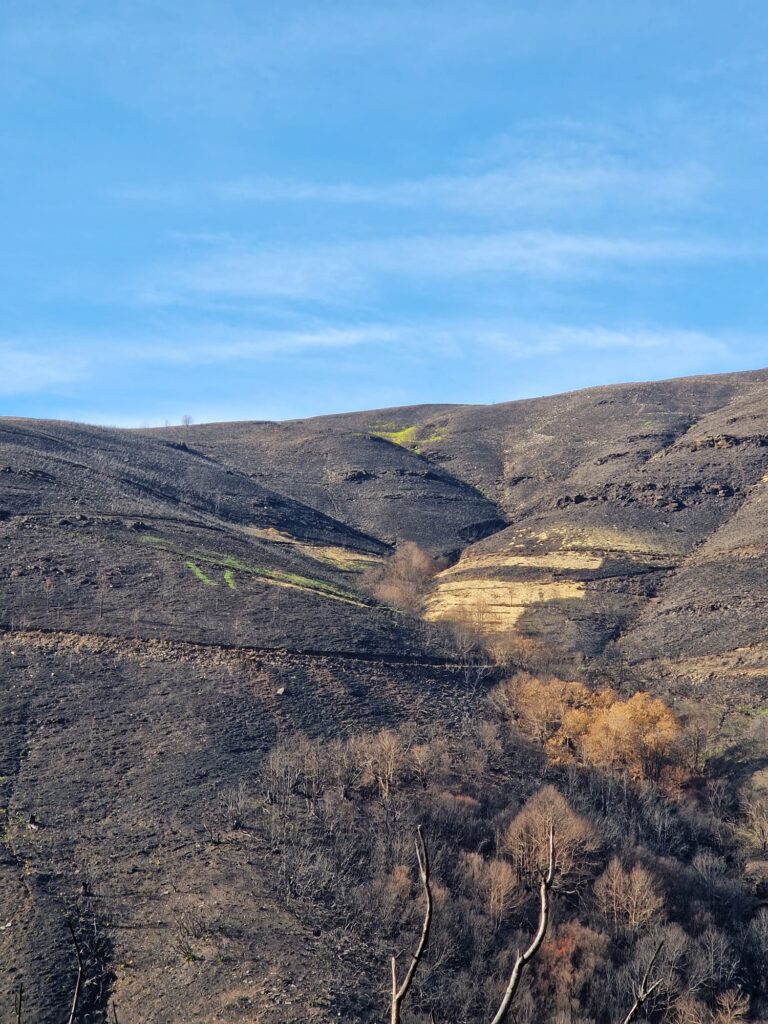
Wildfires do not end when the flames are extinguished. In Galicia, after the major fires of 2025, the real challenge began afterward: thousands of hectares of forest were left bare, covered in ash, and exposed to a silent but devastating process for the soil and the ecosystem.
Sin embargo, incluso en los paisajes más castigados, la naturaleza gallega muestra una enorme capacidad
de resistencia. La cuestión clave es si dejamos que el proceso avance solo, con todos sus riesgos,
o si acompañamos esa recuperación con herramientas que ayuden al territorio a regenerarse mejor y más rápido.
After the fire: what really happens in the soil
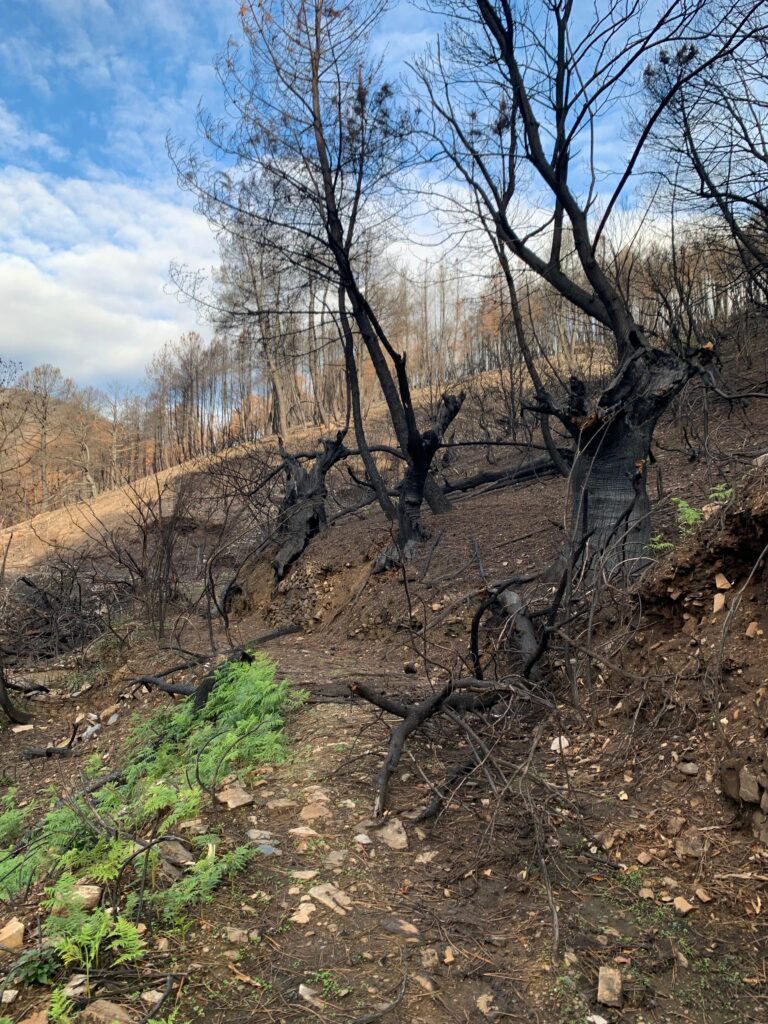
When a wildfire devastates a forest, the loss is not only visual. The disappearance of vegetation removes the layer that protects the soil from rain and wind. High temperatures alter its structure, reduce organic matter, and can create hydrophobic layers that hinder water infiltration.
In a territory like Galicia, with steep slopes and episodes of intense rainfall, this translates into a high risk of erosion. The first rains can carry away large amounts of ash and sediment, further impoverishing the soil and affecting rivers, reservoirs, and agricultural areas.
That is why the months following a fire are critical. Acting in time makes the difference
between a forest that begins to recover and one that enters a process of prolonged degradation.
The first green shoots: a sign that the bush is still alive
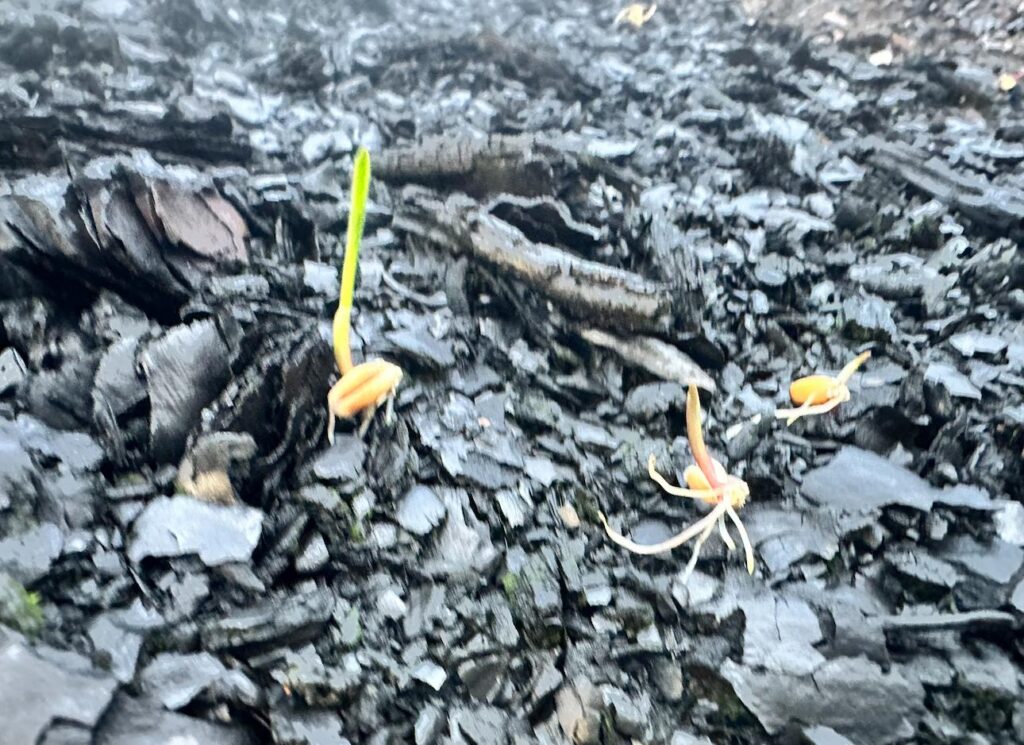
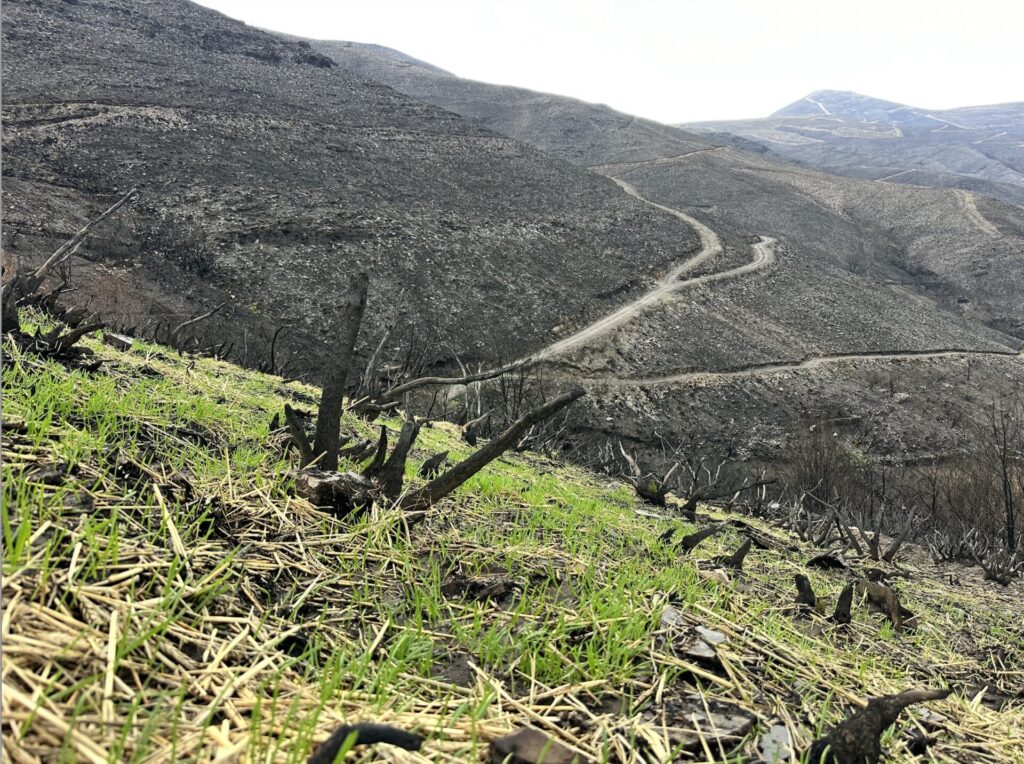
Despite the impact of fire, nature does not give up easily. In many burned areas
green shoots begin to appear a few weeks after the fire. These are the first signs of recovery:
grasses, resprouts of resistant species and seeds that germinate taking advantage of the absence of competition.
These first shoots are essential, but also fragile. If the soil is not protected,
can disappear with the first intense storm. This is where active restoration comes into play,
designed not to replace nature, but to give it a head start.
Grass seeding: a simple solution with great impact
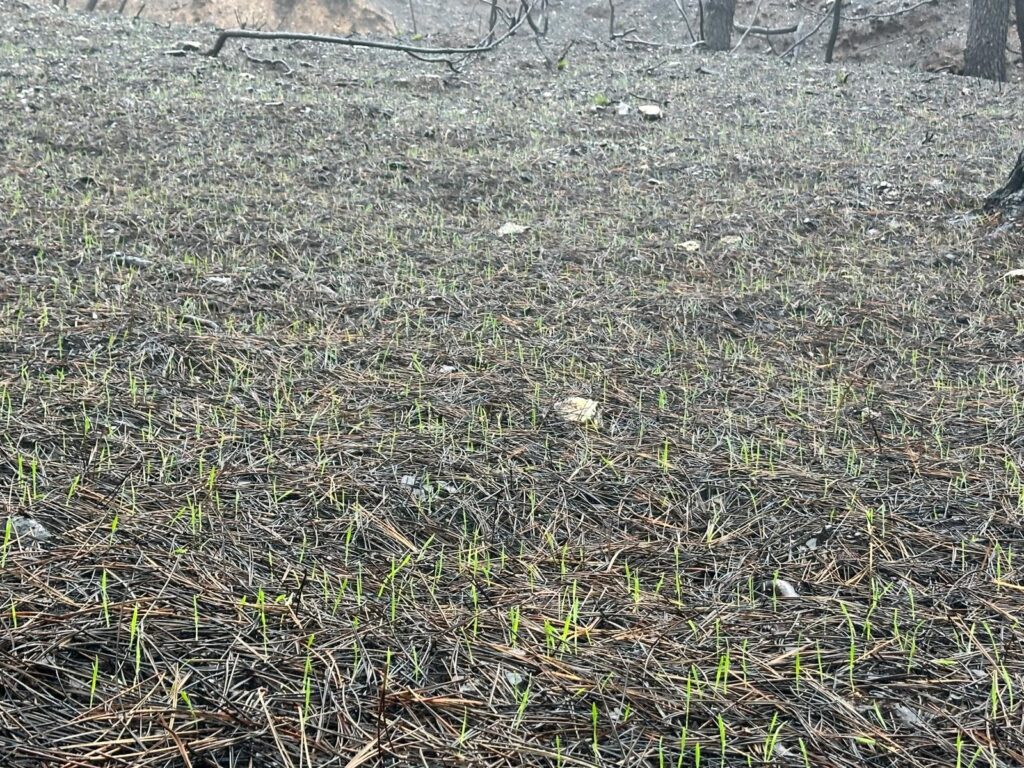
One of the most effective strategies after a fire is the seeding of grasses.
These fast-growing plants play a key role in the early stages
of forest recovery.
Grasses create a vegetative cover that protects the soil, reduces erosion
and improves water retention capacity. They also contribute to fix nutrients
and create a favorable microenvironment for the re-establishment of native species in the ecosystem over time
.
In Galicia, winter cereals such as rye, oats
or triticale, selected for their adaptation to the climate and their ability to germinate
quickly even in soils altered by fire, are commonly used.
The challenge of the field: why it is not always easy to intervene
Although the need for planting is clear, carrying out these actions is not always easy.
Many areas affected by fires are located on steep slopes,
with complicated access or with a high risk for machinery and operators.
Traditional methods can be slow, costly or outright unfeasible
in certain areas. This limitation has prompted the search for more flexible
and efficient solutions to act just when the bush needs it most.
Innovation enters the scene: planting with drones
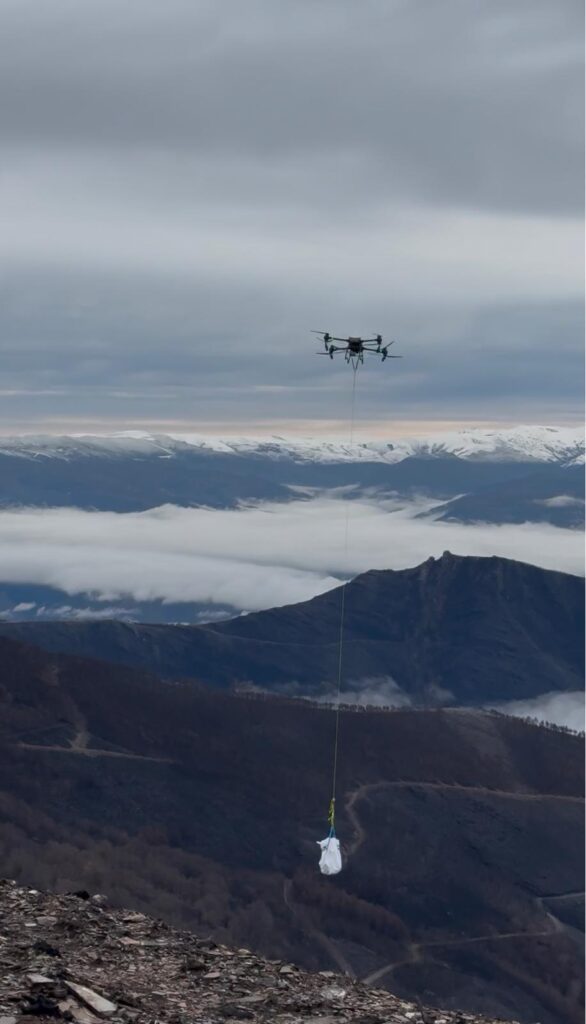
Drone technology has opened a new stage in post-fire restoration.
Aerial seeding allows seeds to be distributed homogeneously over large areas,
accessing areas where other means cannot reach.
Thanks to drones, it is possible to intervene quickly after a fire,
when the soil still retains part of its recovery potential.
Moreover, the precision of the flight and the controlled dosage of seeds
allow optimizing resources and reducing the impact on the ground.
This approach combines technological innovation with environmental knowledge,
making the drone a strategic tool for modern forest management.
A real-life example in Galicia: restoration from the air
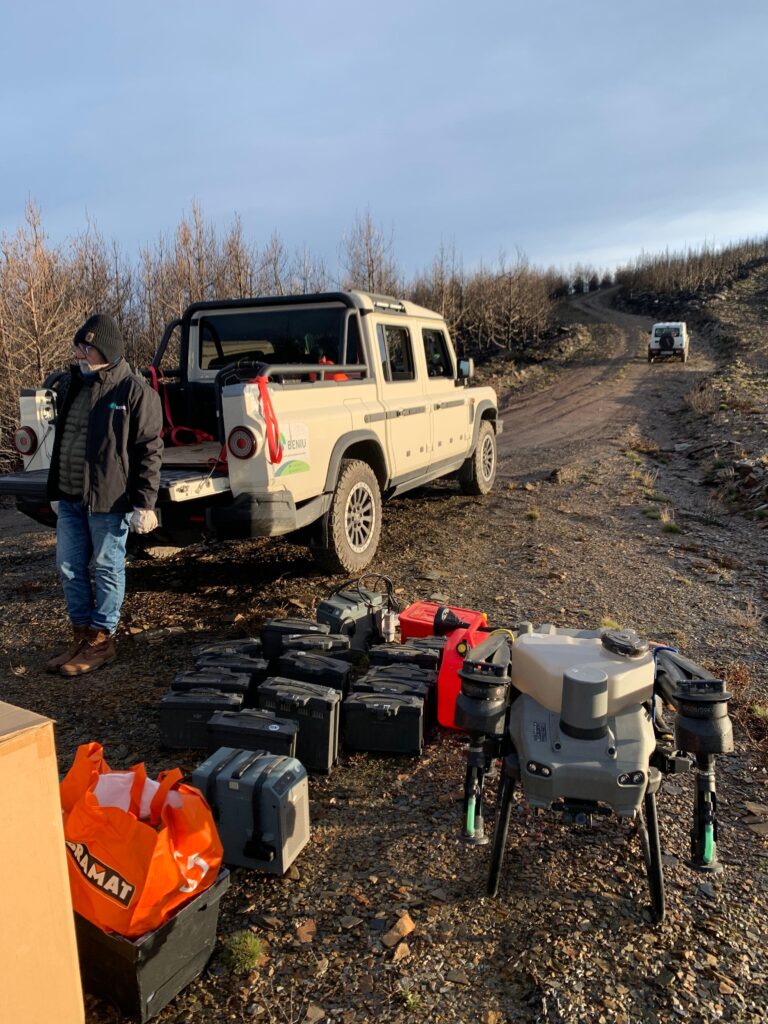
In 2025, in the municipality of Vilamartín de Valdeorras, an action was carried out
to sow grasses with drones over 90 hectares of forest affected by fires.
The main objective was to protect the soil against erosion, favor
the emergence of an early vegetation cover and lay the groundwork for a faster and more sustainable recovery of the ecosystem
.
The collaboration between technology, local administrations and forest communities
demonstrates that there are effective alternatives to act after a fire,
combining speed, respect for the environment and long-term vision.
Looking to the future: restoring today to prevent tomorrow
Forest fires will continue to be one of the great environmental challenges
in the context of climate change. Therefore, restoration should not be understood
only as a punctual response, but as part of a broader land management strategy
.
Acting in the first months after a fire, using innovative solutions
such as seeding with drones, can reduce damage, accelerate recovery
and protect forests against future extreme events.
Because when the fire is extinguished, the most important work begins:
to help the forest to live again.
